
Why your investment timeline matters more than you think
If you’re thinking about investing, the first step isn’t choosing a fund or picking shares – it’s understanding what you want your money to achieve.
As the saying goes, you can’t plan a journey without knowing where you’re going. The same is true when investing. Your financial goals and the timeframe for achieving them can help determine the types of investments that may be suitable for you.
Whether you’re building an emergency fund, saving for a property deposit or planning for retirement, having a clear investment plan can help you make more informed decisions.
Start by defining your investment time horizon
One of the most important factors in any investment plan is your time horizon – in other words, how long you expect to invest before needing access to your money.
Your timeframe can influence both the level of risk you may be comfortable taking and the types of investments you might consider.
Broadly speaking:
Short term: up to 18 months
Medium term: 18 months to 5 years
Long term: 5 years or more
For example, someone saving for a holiday next year may invest differently from someone planning for retirement several decades away.
Understanding investment risk and return
All investments carry risk, and the value of investments can rise or fall.
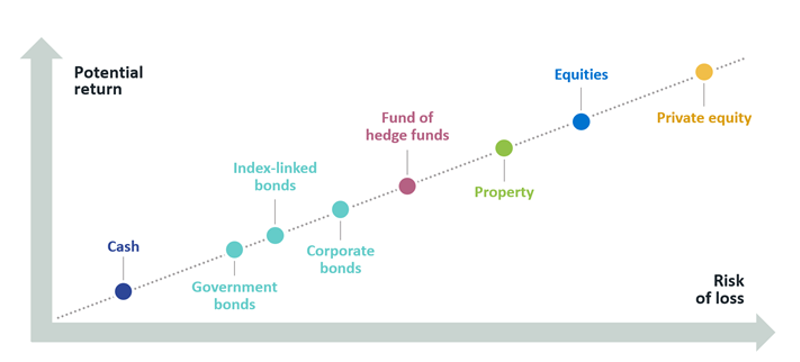
Generally, investments with higher potential returns also involve greater levels of risk. Equities (shares in companies), for example, have historically offered greater long-term growth potential than bonds or cash, but they can also experience larger short-term fluctuations.
Your attitude to risk will depend on your personal circumstances, financial goals and ability to withstand changes in the value of your investments.
Your investment timeframe can also play an important role.
If you expect to need your money relatively soon, you may prefer lower-risk options that aim to preserve capital. However, if your goal is many years away, you may feel more comfortable accepting short-term market movements in pursuit of potential long-term growth.
Saving for the short term (0 – 18 months)
If your goal is within the next 18 months, preserving access to your money may be a priority.
In these circumstances, some people may consider savings products or lower-risk investments such as cash deposits or money market funds.
Examples of short-term goals could include:
Building an emergency fund
Saving for a holiday
Putting money aside for a large upcoming expense
Because time is limited, there may be less opportunity to recover from market falls.
Investing for the medium term (18 months – 5 years)
With a longer timeframe, you may be able to consider a broader range of investment options, including equities, bonds or diversified investment funds.
Funds can offer exposure to a mix of investments within a single portfolio, which may help spread risk.
Examples of medium-term goals include:
Saving for a house deposit
Planning for school fees
Building wealth for a future life event
The appropriate balance between risk and stability will depend on your personal circumstances and investment objectives.
Investing for the long term (5+ years)
A longer investment horizon can provide more opportunity for investments to grow over time.
This is partly because longer timeframes may allow investors to ride out periods of short-term market volatility. Long-term investing can also benefit from the effects of compounding.
Compounding happens when any returns generated by an investment are reinvested, allowing future growth to build on previous gains.
For example, if you invested £5,000 and achieved a 5% annual return, your investment would grow to £5,250 after one year. If returns continued at the same rate, future growth would then be calculated on the larger amount rather than just the original investment.
Over long periods, compounding can have a significant impact on investment growth.
The rate used in this example is for illustrative purposes only. Actual investment returns will vary and are not guaranteed.
Retirement planning is one of the most common examples of a long-term investment goal, although there may be many others.
Other factors to consider when investing
Your investment goals are an important starting point, but they are not the only consideration.
A broader financial plan may also take into account:
Whether you are investing for income, growth or both
Tax considerations
Your wider financial circumstances
The level of diversification within your portfolio
Your capacity for loss
Understanding your objectives can help create a clearer framework for making investment decisions over time.
Final thoughts
Investing without a clear goal can make it harder to choose the right strategy for your circumstances.
By understanding what you are investing for – and when you may need access to your money – you can begin to build an investment approach that aligns with your long-term plans and tolerance for risk.
If you are unsure which approach may be appropriate for your circumstances, consider seeking professional financial advice.
Important Information
The information on this webpage has been produced for educational purposes. Retail investors should not act or rely on any information contained on this webpage without seeking advice from a professional adviser.
This is not intended as a solicitation, or an offer to buy or sell any security. The information on which the material is based has been obtained in good faith, from sources that we believe to be reliable, but we have not independently verified such information and we make no representation or warranty, express or implied, as to its accuracy. All expressions of opinion are subject to change without notice. The information on this webpage should not be relied on for accounting, legal or tax advice, or investment recommendations. Reliance should not be placed on the views and information on this webpage when taking individual investment and/or strategic decisions.
Capital at risk. The value of your investments and any income derived from them can fall as well as rise and you may not get back the amount originally invested. Past performance is not a reliable indicator of future results and may not be repeated. Forecasts are not a reliable indicator of future performance.
Issued by Sarasin & Partners LLP, 50 George Street, London, W1U 7DY. Registered in England and Wales, No. OC329859. Authorised and regulated by the Financial Conduct Authority (FRN: 475111).
© 2026 Sarasin & Partners LLP. All rights reserved.