Our trips to China reveal why smarter robot arms could outpace humanoids, why price wars are here to stay, and how politics now decides where Chinese technology can be sold.
Key points
In robotics, AI that makes standard factory arms more flexible is a bigger opportunity than humanoids.
Chinese overcapacity is structural, pushing firms abroad and keeping global prices low.
Data security, more than tariffs, now decides where Chinese technology can be sold.
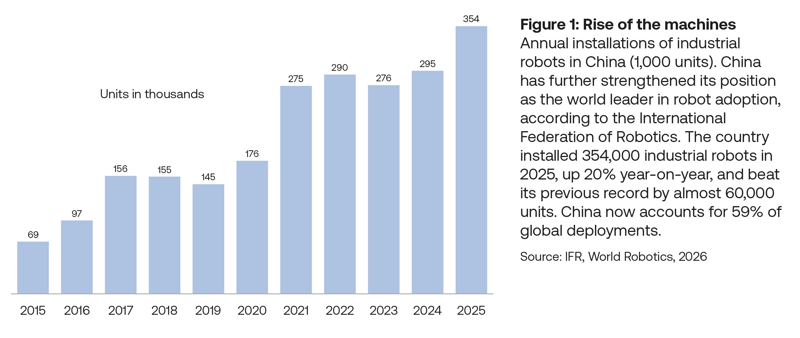
What happens in Chinese factories and boardrooms matters for global investors, even those not invested there directly. A global superpower, China accounts for around 20% of global GDP (in terms of purchasing power parity) and 27% of global manufacturing, while it is also automating fast, having installed 59% of the world’s new industrial robots in 2025. Last year, it also ran a record trade surplus of $1.19trn, a sign of an economy that makes far more goods than it buys. China shapes the prices we pay, the supply chains firms rely on, and the speed at which new technology spreads.
To understand this dynamic better, we made two trips to China this year, meeting 30 companies in robotics, autos, batteries, semiconductors, and software in seven cities.
Three messages came through repeatedly. In factories, the bigger opportunity is AI that makes standard robots more flexible; humanoids suit the smaller share of work that involves moving around. Price competition at home is structural and is pushing firms abroad. And politics increasingly decides where Chinese technology can be sold.
Robots do not need to look like us
‘Physical AI’ has become one of the technology industry’s favourite phrases since Nvidia’s chief executive, Jensen Huang, began promoting it in 2024. Behind the buzzword is a simple idea. A physical AI system combines three things: sensors that read the world around it, such as cameras, lidar (laser scanning that maps surroundings in 3D) or touch sensors; an AI model that decides what to do; and a machine that carries out the action, whether a car, a robot arm or a humanoid.
Humanoids get most of the attention. They are easy to film and easy to relate to. But companies on both trips made the same point: a familiar shape is not the same as a useful one. Factories are highly structured places. They reward precision, accuracy, and low variability, qualities that, with apologies to our readers, are not traditionally associated with the human form. Humanoids are also far harder to build. A standard industrial robot arm has six motorised joints; a humanoid needs dozens, plus legs, balance and hands. Each adds cost and another thing to go wrong.
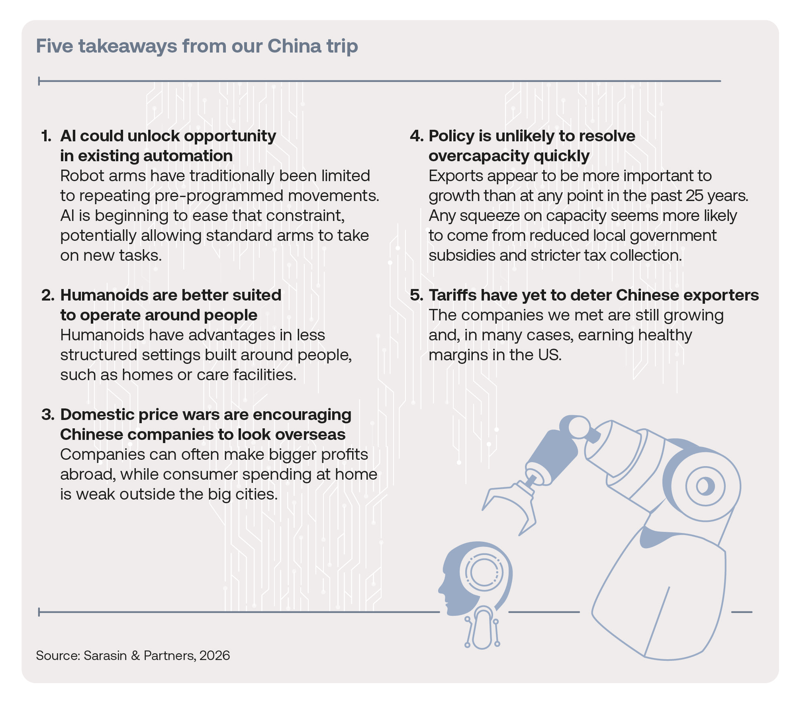
The bigger opportunity lies elsewhere. Much factory work is still done by hand even though it happens at a fixed station and is repetitive: machine operators, assemblers, parts handlers. Traditional automation struggled with these jobs. Robot arms lacked the dexterity to handle awkward or varied parts, and needed costly reprogramming whenever a task changed. Physical AI is tackling both problems. Cameras and AI models let an arm pick from a jumbled bin, adjust its grip and switch tasks without an engineer rewriting its code. Factories can upgrade the robots they already own and automate jobs that were previously out of reach, without paying for a human form they do not need.
Of roughly 500 million manufacturing workers worldwide, we estimate about a quarter do fixed, repetitive work that AI-enabled robot arms can take on now. A further third or so do skilled manual work at a fixed station, such as sewing, welding or woodworking, which better robotic hands could reach over time. Mobile robots, which include humanoids but also wheeled robots and four-legged inspection robots, are best suited to mobile work, such as moving parts around a plant or maintaining equipment, which we think accounts for just over a tenth of roles. Cost will decide how many of these jobs are automated, but on our numbers the balance favours fixed robots, which look suited to about five times as many roles as mobile robots.
As with any generalisation, there is nuance. Humanoids may prove their worth in less structured settings built around people, such as homes or care facilities, where no two tasks are alike. Some factory work may suit them too, such as fetching parts in older plants designed for human workers. But within factories, the larger slice of the pie looks like smarter robots at fixed stations..”
Built for scale rather than returns
Western firms are judged on returns. Chinese ones are often judged on other metrics. Many put market share, jobs and resilience ahead of profit, and expand up and down the supply chain to get them. National government policy and local government incentives encourage this. Local governments compete to attract new entrants and resist consolidation, because a closed factory costs local GDP and jobs. Capital is plentiful, too. High household savings, stuck in a low-return economy, keep flowing to new ventures and investment with low hurdle rates.
The result is that competition does not end when it should. In autos, purchase subsidies have gone and margins are shrinking, yet the market is still crowded, with many weak carmakers kept alive by local backing. New models appear every few days across the industry. Hardware is copied and cheapened quickly. Margin pressure here is a lasting structural feature.
Home demand offers little relief. Consumer spending is weak outside the big cities. Millennials, the generation that grew up with Western brands, have been hurt by the property slump and by tech layoffs that tend to hit workers in their mid-30s. Younger shoppers are doing better but prefer local brands. Meanwhile the old sources of growth – cars and consumer electronics – have matured, and growth has moved to energy storage and AI data centres.
So firms go abroad. Electric vehicle specialist BYD is the clearest case – it reportedly told analysts it made about RMB 20,000 (approx. £2,200) per car sold overseas in the first half of 2026, against analyst estimates of under RMB 3,000 (£330) at home.
Policy from Beijing is likely to manage overcapacity rather than resolve it. Any squeeze is more likely to come from smaller local government subsidies and changes to local government GDP growth key performance indicators than from orders to cut capacity. The rest of the world should expect a steady supply of cheap Chinese goods.
Politics determines business models
Politics now shapes how Chinese firms are built. Sunwoda, a battery maker, keeps its best technology at home and sends older versions abroad, in line with Beijing’s own export controls. Alibaba deliberately avoids the American market. Hesai, a lidar maker, challenged its Pentagon blacklisting in court and won an appeal, though it remains on the list for now. Sharpa, a robotics firm started by Hesai’s co-founders, is headquartered in Singapore, with research and manufacturing in Shanghai. It presents itself as a neutral partner, neither Chinese nor American.
Tariffs are only one of the barriers redrawing supply chains. Local-content rules, safety regulations, and licensing requirements all push production closer to the customer, and Chinese firms are responding by building abroad. BYD is putting a factory in Brazil. Sunwoda is building in Hungary, where licensing and certification alone took about two years. Trade is being rerouted rather than fully cut off.
Data security and national security concerns are harder to get around. The US has banned Chinese driving software from connected cars from the 2027 model year, and a bipartisan bill introduced in March 2026 would bar federal agencies from buying Chinese robots. Exporters whose growth depends on software, data and connected products face the highest barriers.
Politics also sets the pace at home. Beijing is slowing the rollout of driverless taxis to protect the jobs of drivers, many of them gig workers who lost better-paid work elsewhere. It is also subsidising human-made video against AI. In China, worries about jobs decide how fast technology spreads as much as engineering does.
What does this mean for investors?
In automation, the nearer-term opportunity lies in making existing robots smarter: the vision systems, sensors, software and precision components that let a standard arm take on more varied work. These businesses sell into a large installed base and do not need humanoids to succeed. Humanoid makers may yet find their exporters that depend on connected products need more caution. Data security, even more so than tariffs, is the biggest barrier facing Chinese technology abroad. Firms whose growth relies on software and data in sensitive markets face real limits. Those selling plain hardware, or building close to their customers, should be better placed.
Price pressure looks set to persist. Beijing is likely to manage overcapacity in strategic sectors rather than remove it, so cheap Chinese goods will keep coming.
As long-term investors, our job is to find companies within our thematic framework whose competitive advantages cannot be priced away. Examples include brands strong enough to command a premium, products so embedded in a customer’s operations that replacing them is costly and risky, and manufacturing know-how built up over decades that cannot simply be bought or copied.
Stewardship matters here too. China shows that how fast automation spreads is ultimately a social and political choice, not just an engineering one. Where governments are slow to set guardrails, we believe long-term owners have a role to play, pressing the companies building and deploying AI to put safety, transparency and human oversight at the core of the investment case.
Important information
This document is intended for retail investors and/or private clients. You should not act or rely on any information contained in this document without seeking advice from a professional adviser.
This is a marketing communication. Issued by Sarasin & Partners LLP, 50 George Street, London, W1U 7DY. Registered in England and Wales, No. OC329859. Authorised and regulated by the Financial Conduct Authority (FRN: 475111). Website: www.sarasinandpartners.com. Tel: +44 (0)207038 7000. Telephone calls may be recorded or monitored in accordance with applicable laws.
This document has been produced for marketing and informational purposes only. It is not a solicitation or an offer to buy or sell any security. The information on which the material is based has been obtained in good faith, from sources that we believe to be reliable, but we have not independently verified such information and we make no representation or warranty, express or implied, as to its accuracy. All expressions of opinion are subject to change without notice. This document should not be relied on for accounting, legal or tax advice, or investment recommendations. Reliance should not be placed on the views and information in this material when taking individual investment and/or strategic decisions.
Capital at risk. The value of investments and any income derived from them can fall as well as rise and investors may not get back the amount originally invested. If investing in foreign currencies, the return in the investor’s reference currency may increase or decrease as a result of currency fluctuations. Past performance is not a reliable indicator of future results and may not be repeated. Forecasts are not a reliable indicator of future performance.
Neither Sarasin & Partners LLP nor any other member of the J. Safra Sarasin Holding Ltd group accepts any liability or responsibility whatsoever for any consequential loss of any kind arising out of the use of this document or any part of its contents. The use of this document should not be regarded as a substitute for the exercise by the recipient of their own judgement. Sarasin & Partners LLP and/or any person connected with it may act upon or make use of the material referred to herein and/or any of the information upon which it is based, prior to publication of this document.
Where the data in this document comes partially from third-party sources the accuracy, completeness or correctness of the information contained in this publication is not guaranteed, and third-party data is provided without any warranties of any kind. Sarasin & Partners LLP shall have no liability in connection with third-party data.
© 2026 Sarasin & Partners LLP. All rights reserved. This document is subject to copyright and can only be reproduced or distributed with permission from Sarasin & Partners LLP. Any unauthorised use is strictly prohibited.