
Key points
Passive investing is concentrating shareholder voting power in the hands of a small number of fund managers.
Pass-through voting reconnects ownership with accountability by allowing investors to decide how their shares are voted.
Sarasin is implementing custom pass-through voting, strengthening stewardship within passive portfolios.
The shift towards passive investing is reshaping asset management. When ownership is delegated to an index fund, voting powers generally follow. For stewardship, this raises hard questions: is the external manager robustly holding companies to account? Are they voting to reinforce stewardship goals?
These questions matter because voting power has become highly concentrated. The largest index providers are now among the biggest shareholders in almost every listed company, yet their stewardship teams are spread thinly across thousands of holdings. In practice, this can leave engagement at risk of becoming a box-ticking exercise rather than a genuine driver of accountability.
This concentration of influence, combined with rising client demand for passive exposure, sits uneasily alongside Sarasin's commitment to responsible ownership. As a result, we have been searching for a mechanism to deliver the level of stewardship oversight our clients expect, even where assets sit in passive strategies.
The rise of passive
The case for passive exposure in a diversified portfolio has grown steadily over the last decade. For clients seeking broad market coverage at a low cost, index funds serve a clear purpose alongside active strategies. Sarasin and other active managers, by contrast, hold fewer companies by choice – allowing stewardship to be exercised with the depth, context and conviction that meaningful engagement demands.
Figure 1: Passive takes the lead
Passive investment funds have overtaken active funds, reshaping capital flows across global markets.
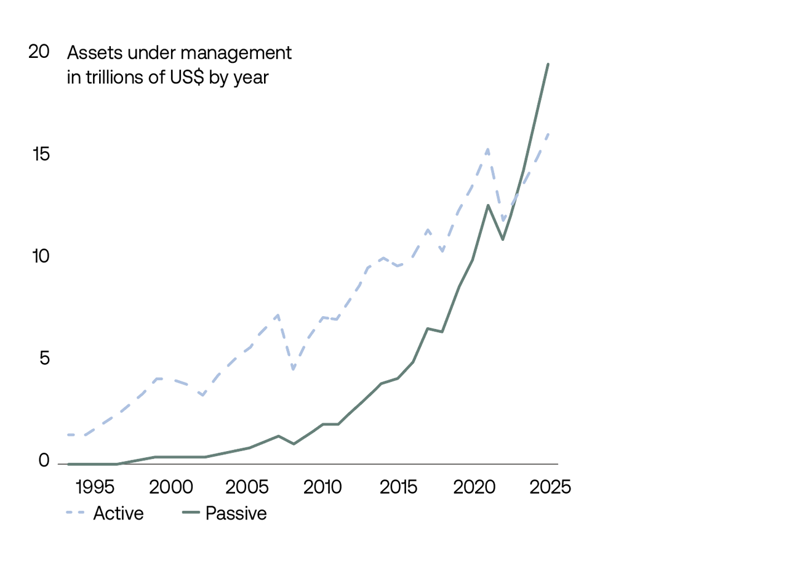
Source: Morningstar Direct. US open-end mutual funds and exchange-traded funds, excluding money market funds, funds of funds, and feeder funds, 2026.
In 2024, US passive mutual funds and ETFs held more assets than active strategies for the first time. By end-2025, passively managed US assets stood at over $19.1trn against $16.2trn in active. In the UK, over a third of funds are now managed passively, with pension funds allocating around 30% of assets to passive vehicles. BlackRock, Vanguard and State Street collectively manage over $30trn and are together the largest shareholder in around 88% of S&P 500 companies, casting roughly a quarter of all votes at their AGMs.
When shares are held through a passive vehicle, voting rights normally sit with the fund manager rather than the underlying investor. For Sarasin, this leads to a potential misalignment between our stewardship commitments and that of the passive manager. Critically, it breaks the link between engagement and voting and, worse still, can result in instances where the third-party manager votes contrary to our internal policies.
The problem with default voting at scale
Large passive managers vote at thousands of AGMs each year. That volume demands systemisation, which in turn produces uniformity. While this does not have to mean weaker voting, in practice it frequently does. In 2024, BlackRock supported 92% of director elections; Vanguard, 94%. Across the Big Three (BlackRock, State Street and Vanguard), average support for management resolutions reached 98.0% in 2024, rising to 98.7% in 2025.
Such blanket support for management points to weak challenge and oversight. By comparison, in 2025 Sarasin voted against management in 32% of total resolutions on our buylist.
Figure 2: A tougher stance on pay
Sarasin & Partners are among the asset managers most willing to vote against executive remuneration, auditor-related proposals and director elections.
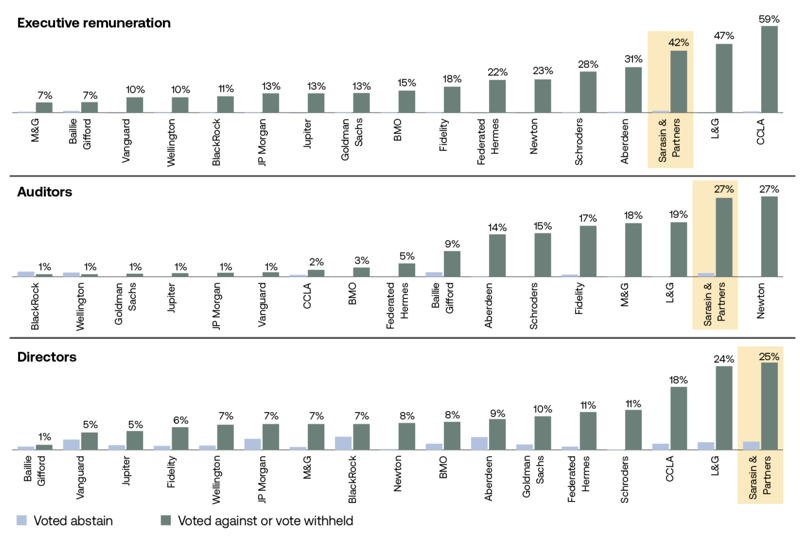
Source: Sarasin & Partners, Diligent. Reporting period: July 2024 to June 2025.
In particular, we voted against 25% of director elections, 27% of auditor-related resolutions, and 42% of remuneration votes – all above our peer average (figure 2).
Today, shareholder rights face pressure due to a rolling back of legal and regulatory protections in the US. Natasha Landell-Mills highlighted some of these in her article in the Q2 2026 House Report, such as the changes at a state level which mean Texas now requires shareholders to hold 3% of a company or $1m of stock merely to file a proposal, while Delaware has curtailed investors' inspection rights and shielded conflicted transactions from judicial scrutiny.
There has also been a clear erosion of governance standards in the UK, including the 2024 listing reforms that swept away one-share one-vote and shareholder approval of significant transactions. In this environment, passive funds voting in near-unison with management compounds the problem of lowering accountability of corporate management.
While the principle is straightforward, the infrastructure to make it work has, until recently, been the obstacle. However, to combat that problem, Sarasin has recently begun working with an innovative fintech company, Tumelo, to implement our voting policies for a subset of our passive holdings.
Tumelo is a UK voting fintech that has been building that infrastructure since 2018. Its ProxySphere platform enables institutional and retail investors in pooled funds to exercise voting rights that would otherwise rest with the passive manager.
While a technological solution is now available, the challenge is encouraging passive managers to offer clients Tumelo's service. As part of our systemic stewardship efforts, we met with leading passive index managers to advocate for the adoption of Tumelo's pass-through voting infrastructure, with the objective of enhancing market dynamics and ensuring that shareholders are better able to express their voting preferences.
Figure 3: Giving investors the final say
Pass-through voting allows investors to decide how their shares are voted, rather than delegating decisions to their fund manager.
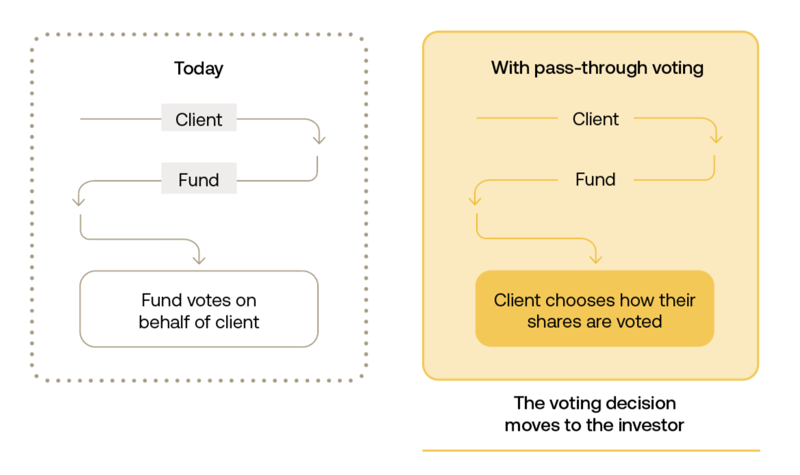
Source: Tumelo, 2026
As a result of our and other clients' demand, Vanguard now offers a menu of pre-packaged voting policies on a selection of its funds. State Street Investment Management has gone further, allowing direct votes on a resolution-by-resolution basis enabling clients to apply their own custom voting policy. Sarasin is one of the first State Street clients to gain approval for Tumelo-enabled custom voting.
What this means for clients
Sarasin's outreach to Tumelo and key index fund providers means we are now able to offer our clients exposure to a State Street MSCI ACWI fund, while continuing to vote and engage on our clients' key holdings. While this is just a start, we are working to expand both the number of companies we are voting and passive managers where we can exercise pass-through voting.
In a world where trillions of dollars sit behind a handful of default voting policies, the dangers of ownerless corporations grow, raising risks of broader market dysfunctionality. The tools to address this now exist. For asset managers that take stewardship seriously, the question is whether they choose to use them.
Important information
This document is intended for retail investors and/or private clients. You should not act or rely on any information contained in this document without seeking advice from a professional adviser.
This is a marketing communication. Issued by Sarasin & Partners LLP, 50 George Street, London, W1U 7DY. Registered in England and Wales, No. OC329859. Authorised and regulated by the Financial Conduct Authority (FRN: 475111). Website: www.sarasinandpartners.com. Tel: +44 (0)207038 7000. Telephone calls may be recorded or monitored in accordance with applicable laws.
This document has been produced for marketing and informational purposes only. It is not a solicitation or an offer to buy or sell any security. The information on which the material is based has been obtained in good faith, from sources that we believe to be reliable, but we have not independently verified such information and we make no representation or warranty, express or implied, as to its accuracy. All expressions of opinion are subject to change without notice. This document should not be relied on for accounting, legal or tax advice, or investment recommendations. Reliance should not be placed on the views and information in this material when taking individual investment and/or strategic decisions.
Capital at risk. The value of investments and any income derived from them can fall as well as rise and investors may not get back the amount originally invested. If investing in foreign currencies, the return in the investor’s reference currency may increase or decrease as a result of currency fluctuations. Past performance is not a reliable indicator of future results and may not be repeated. Forecasts are not a reliable indicator of future performance.
Neither Sarasin & Partners LLP nor any other member of the J. Safra Sarasin Holding Ltd group accepts any liability or responsibility whatsoever for any consequential loss of any kind arising out of the use of this document or any part of its contents. The use of this document should not be regarded as a substitute for the exercise by the recipient of their own judgement. Sarasin & Partners LLP and/or any person connected with it may act upon or make use of the material referred to herein and/or any of the information upon which it is based, prior to publication of this document.
Where the data in this document comes partially from third-party sources the accuracy, completeness or correctness of the information contained in this publication is not guaranteed, and third-party data is provided without any warranties of any kind. Sarasin & Partners LLP shall have no liability in connection with third-party data.
© 2026 Sarasin & Partners LLP. All rights reserved. This document is subject to copyright and can only be reproduced or distributed with permission from Sarasin & Partners LLP. Any unauthorised use is strictly prohibited.