
Staggered board elections can weaken shareholders’ ability to hold directors to account. Sarasin is campaigning for annual elections to strengthen corporate governance.
Key points
Staggered boards can leave shareholders waiting three to five years to vote on individual directors.
Sarasin is working with investors, regulators, and standard-setters to promote annual director elections
Annual elections strengthen accountability by allowing shareholders to direct concerns at the responsible directors.
In September 2025, Sarasin & Partners launched the investor collaboration ‘Annual director elections to ensure board accountability’ on the Principles for Responsible Investment (PRI) Collaboration Platform. The initiative aims to strengthen shareholders’ ability to hold directors accountable. Its starting point is simple: the right to vote on every director, every year, is a basic shareholder right. Without that right, accountability in the boardroom weakens.
The collaboration now includes five investors with combined assets under management of around $400bn, and one PRI-member consultant.
The problem: staggered boards and delayed accountability
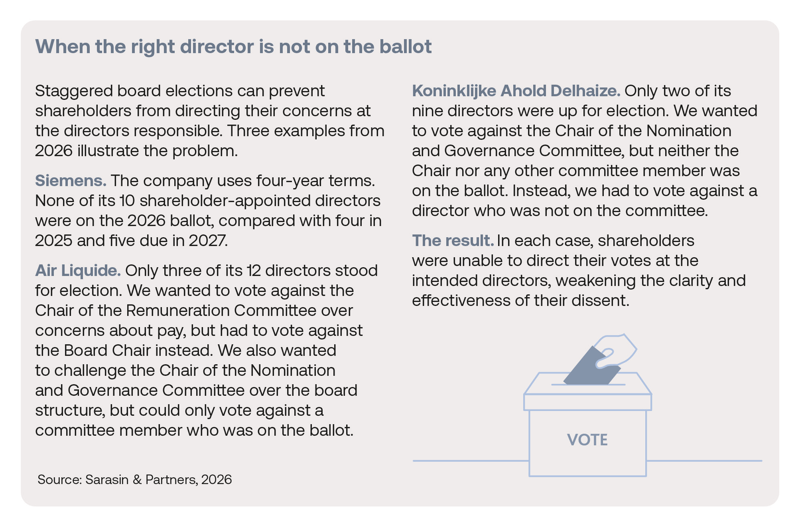
Many European companies have staggered board structures. Directors are elected for multi-year terms, and only part of the board stands for election in any given year. As a result, shareholders may be able to vote on an individual director only once every three, four, or even five years.
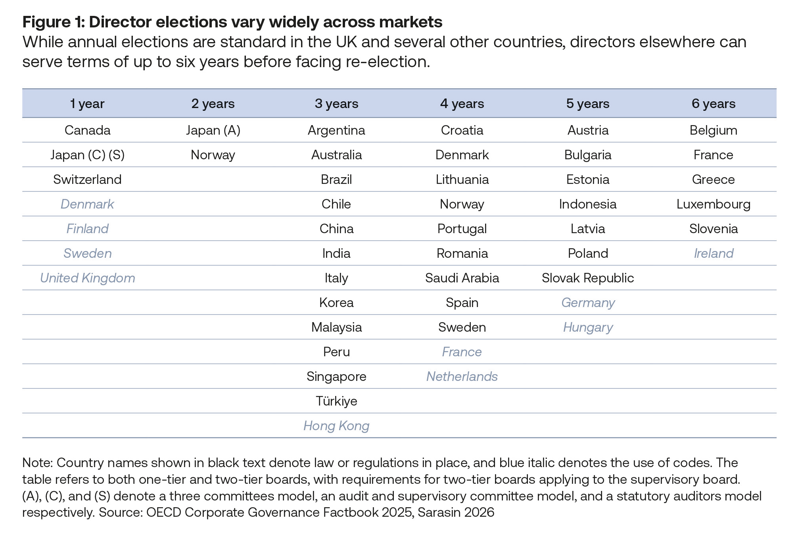
This practice rests on a permissive legal framework. For example, the German Stock Corporation Act (Aktiengesetz, or AktG) allows Supervisory Board members to be elected for terms of up to five years. French company law (Code de commerce) allows up to six years.
The French corporate governance code of the Association française des entreprises privées (AFEP) and the Mouvement des entreprises de France (MEDEF) recommends director terms of up to four years. The Dutch Corporate Governance Code likewise provides for four-year terms (see box ‘When the right director is not on the ballot’ for examples).
From company engagement to systemic stewardship
The collaboration began with direct company engagement. Sarasin and its co-signatories wrote to more than 30 portfolio companies, mainly in Europe, that have staggered board structures. The letters set out our concerns and invited each company to a call. Most companies agreed to meet, and we presented the case for annual elections of every director.
Most companies pushed back on two grounds. First, companies noted that they comply with the law and the governance code in their jurisdiction, which is correct. Second, they argued that staggered terms support board stability and continuity. Only one company, Siemens Healthineers, said it would consider moving away from a staggered structure as part of its upcoming governance reform.
The contrast with the US is striking. In the 2010s, a large number of US companies removed their staggered boards. Academic research by Lucian Bebchuk and colleagues had linked staggered boards to lower firm value, notably in a paper called ‘The Costs of Entrenched Boards’.
Given the limited movement at company level, we shifted to systemic stewardship and began seeking policy reform. As the global standard-setter, the OECD Corporate Governance Committee, responsible for the G20/OECD Corporate Governance Principles, was a natural first step. We wrote to its Sustainable Finance and Corporate Governance teams and held a call to discuss practical ways the OECD could help promote better governance standards.
We are also engaging regulators in countries whose company law or governance codes support staggered boards. We have started with France and Germany and will follow with the Netherlands, Spain, and Italy.
In Germany, we held a call with the Government Commission on the German Corporate Governance Code as part of an engagement led by the International Corporate Governance Network (ICGN). We also responded to the German Code consultation, which closed on 4 September 2026.
Why annual elections matter
Our first argument concerns ownership rights. As investors, we want a say in the composition of the board that represents our interests. We vote at the AGM every year, and director elections should follow the same cycle. Without annual votes, shareholders lose a timely voice, directors become entrenched, and accountability weakens.
When investors vote against a director, the aim is usually to signal a concern rather than to remove that individual. A vote against the Chair of the Nomination and Governance Committee typically reflects concern about board composition. A vote against the Chair of the Audit Committee points to weaknesses in internal controls or reporting. A vote against the Chair of the Remuneration Committee signals concern that incentives are not aligned with performance or shareholder interests. In critical cases, investors may vote against the Board Chair when the board as a whole is not working well. We also vote against non-independent directors who sit on board committees, as a safeguard against entrenchment.
This targeted signalling only works if the right director is on the ballot at the right time. We believe that votes against directors can be more effective than shareholder resolutions, but only when they happen every year.
Standards matter because legal reform takes time. Current company law does not stop companies from adopting better practice. It sets only the maximum interval between director elections, and companies are free to set a shorter interval in their articles. The push for change comes from international standards and principles of good governance. For example, Principle 3.7 of the ICGN Global Governance Principles states that “Directors should be elected to the board preferably on an annual basis”. Annual elections are already standard in Canada, Switzerland, and the UK, at many Japanese companies, and at most large US companies.
Investors should help shape these standards. Boards represent shareholders’ interests, so shareholders should have a say in how directors are appointed.
Answering the objections
Stability and long-term focus. We have seen no evidence that annual elections undermine long-term focus or board stability. Length of tenure is a separate question. A director can remain on the board for as long as their independence status allows, provided they win majority shareholder support at each AGM.
Board succession discipline. One argument we have heard is that a three-year cycle makes the Chair’s review of board composition more meaningful, while annual reconfirmation risks becoming a “rubber stamp”. We disagree. Annual elections do not stop the nomination committee from running a multi-year succession review on whatever timetable it chooses. If deliberateness is the concern, the answer is procedural, such as a required periodic review, not a longer interval between votes.
Under annual elections, the committee must actively repropose every director every year. Under a three-year cycle, a director can go years without the question being formally revisited. An annual proposal is, if anything, the more disciplined default. Neither the academic literature nor the ICGN’s experience of UK and large US boards, where annual elections have been standard for more than a decade, shows any documented weakness in succession planning.
Clarity of signal and the limits of discharge votes. Annual votes give the board a clearer reading of investor sentiment on individual directors. Without them, shareholders redirect their dissent towards whichever directors are standing, towards discharge votes, or towards the financial statements. These outcomes are much harder to interpret.
Discharge votes, which exist only in certain jurisdictions, are no substitute. They are not an established global practice and international investors rarely use them, as voting results show. Some shareholders vote against discharge as a matter of routine, to preserve their right to take legal action against the company. A majority vote against discharge has no immediate legal effect on a director’s seat, and companies often play it down.
A failed election, by contrast, generally ends the mandate, although not everywhere; the US is an exception. Finally, discharge looks only backwards. It absolves past conduct and does nothing to hold directors accountable going forward. For these reasons, discharge votes cannot provide the direct accountability that an election does.
The right to remove directors. In practice, removal is an exceptional tool with high hurdles. In Germany, placing a removal proposal on the agenda requires 5% of share capital or €500,000 in nominal value, and removal needs three-quarters of the votes cast. France requires only a simple majority, but filing a resolution at a large company still needs a stake of around 0.5% of capital, which at the largest companies can be worth hundreds of millions of euros.
In the Netherlands, filing requires 3% of capital, the board can delay the vote by up to 250 days, and at companies under the large-company regime (structuurregime), shareholders can only dismiss the entire Supervisory Board. Removal is therefore a confrontational last resort and no substitute for the routine accountability of an annual vote.
Next steps
As founder of the collaboration, Sarasin & Partners will continue to press standard-setters, regulators, and companies to adopt annual elections for every director. We invite fellow investors to join the initiative through the PRI Collaboration Platform.
Important information
This document is intended for retail investors and/or private clients. You should not act or rely on any information contained in this document without seeking advice from a professional adviser.
This is a marketing communication. Issued by Sarasin & Partners LLP, 50 George Street, London, W1U 7DY. Registered in England and Wales, No. OC329859. Authorised and regulated by the Financial Conduct Authority (FRN: 475111). Website: www.sarasinandpartners.com. Tel: +44 (0)207038 7000. Telephone calls may be recorded or monitored in accordance with applicable laws.
This document has been produced for marketing and informational purposes only. It is not a solicitation or an offer to buy or sell any security. The information on which the material is based has been obtained in good faith, from sources that we believe to be reliable, but we have not independently verified such information and we make no representation or warranty, express or implied, as to its accuracy. All expressions of opinion are subject to change without notice. This document should not be relied on for accounting, legal or tax advice, or investment recommendations. Reliance should not be placed on the views and information in this material when taking individual investment and/or strategic decisions.
Capital at risk. The value of investments and any income derived from them can fall as well as rise and investors may not get back the amount originally invested. If investing in foreign currencies, the return in the investor’s reference currency may increase or decrease as a result of currency fluctuations. Past performance is not a reliable indicator of future results and may not be repeated. Forecasts are not a reliable indicator of future performance.
Neither Sarasin & Partners LLP nor any other member of the J. Safra Sarasin Holding Ltd group accepts any liability or responsibility whatsoever for any consequential loss of any kind arising out of the use of this document or any part of its contents. The use of this document should not be regarded as a substitute for the exercise by the recipient of their own judgement. Sarasin & Partners LLP and/or any person connected with it may act upon or make use of the material referred to herein and/or any of the information upon which it is based, prior to publication of this document.
Where the data in this document comes partially from third-party sources the accuracy, completeness or correctness of the information contained in this publication is not guaranteed, and third-party data is provided without any warranties of any kind. Sarasin & Partners LLP shall have no liability in connection with third-party data.
© 2026 Sarasin & Partners LLP. All rights reserved. This document is subject to copyright and can only be reproduced or distributed with permission from Sarasin & Partners LLP. Any unauthorised use is strictly prohibited.