
Investing always involves balancing risk and potential reward. Understanding how risk and return work together can help investors make more informed decisions and build a portfolio aligned with their financial goals and personal circumstances.
What is the risk-return trade-off?
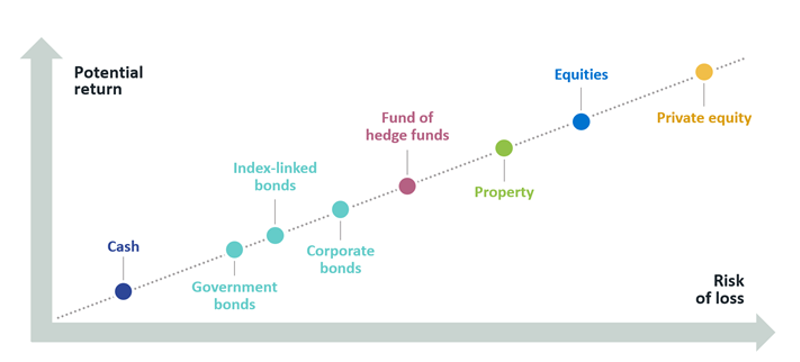
One of the core principles of investing is the relationship between risk and return. Generally, investments that carry a higher level of risk may offer greater potential returns over the long term. However, this increased return potential also comes with a greater possibility of losses, including the loss of capital.
This relationship is known as the risk-return trade-off.
Investors seeking higher returns typically need to accept a greater degree of uncertainty and market volatility. Conversely, lower-risk investments may offer more stable and predictable outcomes, but often with lower long-term growth potential.
Importantly, higher risk does not guarantee higher returns. The value of investments can rise and fall, and investors may get back less than they originally invested.

Understanding the risk-return spectrum
Different types of investments sit at different points along the risk-return spectrum. In general, the higher the expected return, the greater the level of investment risk required.
Equities
Equities, also known as shares, represent part ownership in a company. Historically, equities have delivered higher long-term returns than many other asset classes, but they are also typically more volatile.
Equity prices can fluctuate due to economic conditions, company performance, interest rates and investor sentiment. As a result, investors should be prepared for periods of short-term market volatility.
Bonds
Bonds are loans made by investors to governments or companies in exchange for regular interest payments and the return of capital at maturity.
Government bonds issued by developed economies, such as UK gilts or US treasuries, are often viewed as lower-risk investments compared with equities. However, they are not risk-free, and bond prices can still fall due to changes in interest rates, inflation expectations or credit quality.
Corporate bonds may offer higher income potential than government bonds, but they generally carry greater credit risk.
Multi-asset funds
Multi-asset funds invest across a range of asset classes, which may include equities, bonds, cash and alternative investments. Their risk profile will depend largely on their underlying asset allocation.
For example, a multi-asset fund with a higher allocation to equities may suit investors seeking greater long-term growth potential and who are comfortable with higher levels of volatility. A fund with a larger allocation to bonds or cash may appeal to more cautious investors prioritising stability and capital preservation.
Diversification across different asset classes can help reduce overall portfolio risk, although it does not eliminate the possibility of losses.
Risk tolerance and investment time horizon
An investor’s willingness and ability to take risk will depend on several factors, including their financial goals, investment time horizon and personal circumstances.
Investors with a longer time horizon may be better positioned to withstand short-term market fluctuations, as they have more time for their investments to recover from periods of volatility. Similarly, individuals with greater financial security may feel more comfortable accepting higher levels of investment risk.
However, risk tolerance is highly personal. Some investors are comfortable with fluctuations in the value of their investments, while others may prefer a more cautious approach focused on preserving capital and reducing volatility.
Understanding your attitude to risk is an important part of building an investment strategy that reflects your objectives and financial circumstances.
Why understanding risk matters
Taking too little risk may limit the ability of investments to grow over time, particularly after inflation. On the other hand, taking more risk than you are comfortable with can make it harder to stay invested during periods of market volatility.
A well-balanced investment strategy should consider both your financial goals and your tolerance for risk, helping you remain focused on long-term objectives through changing market conditions.
Frequently asked questions:
What is the relationship between risk and return?
In investing, higher-risk investments may offer greater potential returns, but they also carry a higher chance of losses. Lower-risk investments typically offer lower potential returns with greater stability.
Are higher-risk investments always better?
Not necessarily. Higher-risk investments do not guarantee higher returns and may experience greater volatility. The right level of risk depends on an investor’s financial objectives, time horizon and personal circumstances.
What are examples of lower-risk investments?
Government bonds and cash are generally considered lower-risk investments compared with equities, although all investments carry some level of risk.
What is a multi-asset fund?
A multi-asset fund invests across several asset classes, such as equities and bonds, with the aim of diversifying risk and achieving a balance between growth and stability.
Important Information
The information on this webpage has been produced for educational purposes. Retail investors should not act or rely on any information contained on this webpage without seeking advice from a professional adviser.
This is not intended as a solicitation, or an offer to buy or sell any security. The information on which the material is based has been obtained in good faith, from sources that we believe to be reliable, but we have not independently verified such information and we make no representation or warranty, express or implied, as to its accuracy. All expressions of opinion are subject to change without notice. The information on this webpage should not be relied on for accounting, legal or tax advice, or investment recommendations. Reliance should not be placed on the views and information on this webpage when taking individual investment and/or strategic decisions.
Capital at risk. The value of your investments and any income derived from them can fall as well as rise and you may not get back the amount originally invested. Past performance is not a reliable indicator of future results and may not be repeated. Forecasts are not a reliable indicator of future performance.
Issued by Sarasin & Partners LLP, 50 George Street, London, W1U 7DY. Registered in England and Wales, No. OC329859. Authorised and regulated by the Financial Conduct Authority (FRN: 475111).
© 2026 Sarasin & Partners LLP. All rights reserved.