
View from the desk of the Chief Market Strategist
Equity and bond markets are viewing the global economy through different lenses – and this offers opportunities for multi-asset investors
In September, The Economist ran the headline: ‘Soaring bond yields, gaping deficits and towering debts: what could go wrong?’ Add rising interest rates around the world, and oil prices that have climbed 70% this year, and the backdrop for asset prices looks pretty grim. Or does it?
For bond investors, it has certainly been challenging. US 30-year Treasury yields climbed above 5.6% in late September, the highest since 2002, while UK 30-year gilts touched 6% on 1 October, a level not seen in almost three decades. In the short term, the surge in energy prices has revived inflation fears; over the longer term, concerns about government debt sustainability continue to push up the term premium.[1]
By contrast, equity investors seem to inhabit a very different world. Stockmarket indices hit new records at the end of September, with the MSCI World delivering returns well into double digits in 2026. Geographically, the gains have broadened out compared to 2025, with US and European equities performing remarkably similarly, but they have continued to be predominantly technology-led.
More striking still, this broad-based equity rally has arrived with surprisingly little fuss. The VIX index, which measures volatility in the S&P 500, was trading at just 16 at the end of September, comfortably below its 20-year average of 19.4.
This stands in sharp contrast to the MOVE index, its counterpart in the Treasury market, where volatility remains well above its long-term average as bond yields have climbed to new highs.
Why are equity investors cheering just as bond investors run for the door?
So why are equity investors confident enough to look through today’s complex geopolitical and economic risks, while bond investors appear to be making a disorderly dash for the exit? The answer, in part, is that the same economic forces are sending very different signals to the two markets.
America is now enjoying something close to an inflationary boom, with nominal growth running at an extraordinary 6.3% annualised. Euro area nominal growth, at 4.4%, is robust too. Indeed, for much of the past 20 years nominal GDP growth of 4% seemed close to the ceiling for Western economies. Today, it looks more like a floor (Chart 1).
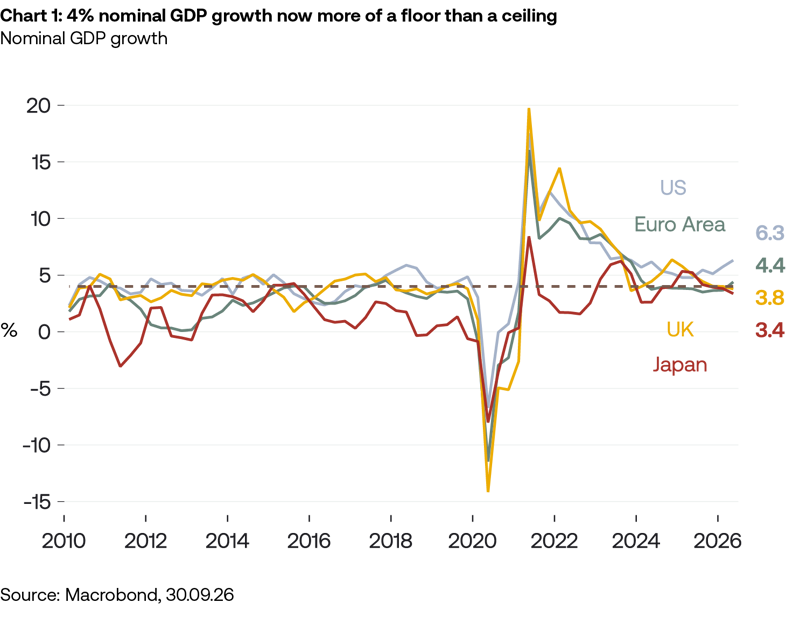
This matters because equities and bonds respond very differently to strong nominal growth. For companies it means rising revenues and, where margins can
be maintained, rising profits. For bondholders it brings the threat of persistent inflation, higher policy rates and ultimately higher yields. In other words, what looks like an earnings boom through the equity lens can look rather more like an inflation problem through the bond lens.
The drivers of global growth today are clear
The causes of this growth surge are not hard to find: strong business investment led by AI infrastructure, deficit-financed government spending and a resilient consumer – supported by positive wealth effects – have all contributed.
Business investment has been particularly strong, driven increasingly by the enormous capital requirements of AI. Data centres need not only semiconductors and servers, but also electricity generation, grids, cooling systems, construction and industrial equipment. The investment boom is therefore spreading well beyond the handful of technology companies that initially dominated the AI story.
Consumers, meanwhile, have been supported by strong household balance sheets and buoyant asset markets. Fidelity recently reported that the number of 401(k)[2] accounts it administers holding more than $1m surged 19% during the second quarter to a record 769,000. Rising equity prices continue to provide a powerful wealth effect for many households.
For equity markets these are powerful supports for corporate revenues and earnings. For bond investors, however, strong private investment combined with large fiscal deficits can create competition for capital just as governments need to issue larger quantities of debt.
The US economy is running hot
The result is a US economy that looks to be running hot. Inflation, on the Federal Reserve’s preferred gauge, the PCE price index, is 3.4%, well above its 2% target, which the central bank has now missed for five years in a row.
The latest acceleration in headline inflation has been driven in large part by sharply higher global energy costs. So far, however, there is little evidence that these are feeding decisively into longer-term inflation expectations, which remain broadly stable in both the US and Europe. That helps explain why equity markets have been relatively relaxed: investors are still treating much of the energy shock as a hit to the price level rather than the beginning of another inflationary spiral.
Bond investors have less room for complacency. Even if inflation expectations remain anchored, stronger nominal growth and higher current inflation make rapid interest-rate cuts increasingly unlikely. They also raise the risk that policy rates remain higher for longer.
The UK faces a similar problem. Headline inflation, at 3.1%, is being pushed higher principally by the global energy shock, but Britain’s sticky services inflation means the underlying picture is less benign than the core rate of 2.6% suggests. The Bank of England therefore has little room simply to look through higher oil prices.
Why are bond and equity markets reading the data so differently?
Which brings us back to the puzzle. Why have equities barely blinked at these inflationary warning lights, while global bond markets have sold off so sharply? There are four further explanations.
First, fiscal sustainability. The increase in 10-year bond yields in 2026 has been particularly aggressive in France (+130bps), the US (+113bps) and the UK (+96bps), all of which face daunting long-term budgetary challenges. In France, two governments have already fallen while trying to pass a budget and markets are sceptical that Prime Minister Lecornu’s 2027 budget, unveiled at the beginning of October, will survive parliament – French government bond yields are already at their highest since 2002.
Meanwhile, in the UK, Prime Minister Burnham is sticking to his predecessor’s fiscal rules, but with the promise of tightening only towards the end of his term.
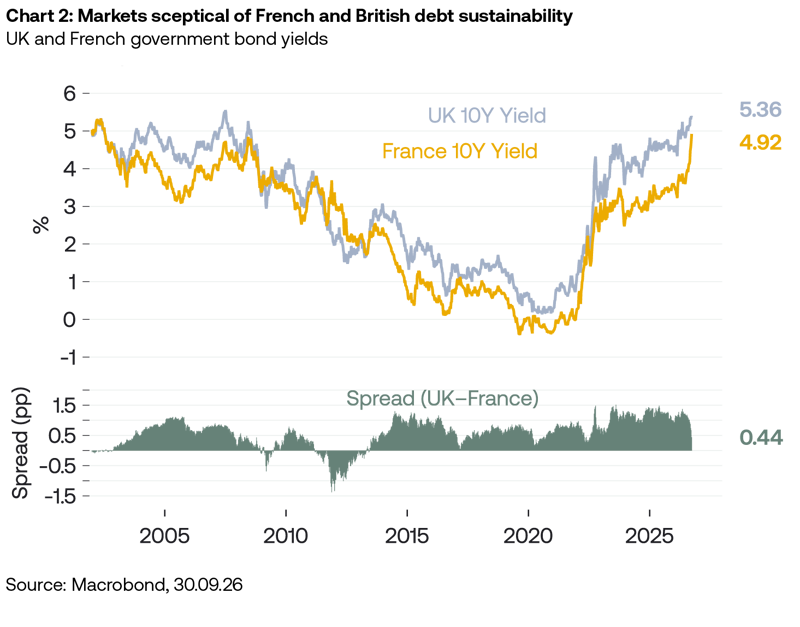
For bondholders this matters today. Governments must refinance existing debt and fund new deficits in markets that are already being asked to finance an extraordinary private-sector investment boom. Investors therefore demand a higher yield to hold long-dated government debt. For an equity market much more focused on next quarter’s earnings, fiscal sustainability can still be treated as tomorrow’s problem.
Second, strong nominal growth also means strong profits. The extraordinary profit boom in the hyperscalers after the pandemic has migrated to semiconductors and memory on the back of AI demand. It is now broadening out to industrial equipment and metals.
Nor is it just AI spending. The Trump White House, for all its faults, is strongly pro-business. The One Big Beautiful Bill Act (OBBBA) of July 2025 has delivered a sizeable corporate tax windfall: the CBO puts the reduction in corporate tax receipts at almost $100bn this year. That is good for corporate earnings and cash flow, but a challenge for government finances – and Treasury bonds. Once again, the same policy can look positive to an equity investor and troubling to a bondholder.
Third, monetary policy has changed. There is a new Chair at the Federal Reserve, Kevin Warsh, who surprised markets with his hawkish tone at the September FOMC meeting. In raising rates by 25bps (0.25%) and strongly recommitting to the 2% inflation target, he made clear that the move was removing a “dose of accommodation”, implying that further rate rises may be in the offing. Market pricing now shows a high probability that US rates will be at least another 25bps higher by the December FOMC meeting.
There remains, however, a lingering sense that the White House would prefer lower rates. Its continuing pressure on the Federal Reserve, including its efforts to remove Governor Lisa Cook over mortgage-fraud allegations, which she denies, has not disappeared. Bond investors are therefore probably still demanding some additional risk premium for the governance risks surrounding the central bank.
Finally, technical factors may now be amplifying the sell-off. The five large hyperscalers [3] alone have issued about $220bn of debt this year, according to LSEG data. While this is not in itself especially significant relative to the size of global capital markets, debt-funded investment in AI capacity and data centres is competing for capital at the same time as government issuance is rising.
There is also evidence, reported by the Financial Times, that hedge funds and other leveraged investors have been forced to sell long-duration bonds as losses mount or risk limits are breached. It is difficult to know how significant this is, but such selling can become self-reinforcing. Rising yields create losses, losses force investors to reduce risk, and that selling pushes yields higher still. What began as selling by the ‘bond vigilantes’ may now, at the margin, have become an issue of leverage.
For investors there is one other particularly encouraging development. This year is on pace to be the first since 2021 in which stock and bond prices have moved in opposite directions. That matters because negative correlation between the two asset classes is the cornerstone of the classic 60/40 portfolio: when equities stumble, bonds can provide ballast, and vice-versa.
That relationship broke down painfully during the inflation shock of 2022, when both asset classes fell together. Today we have other tools in our alternatives box, including commodities and other real assets, that can provide additional diversification. But a bond allocation that provides useful diversification is important for overall client outcomes.
So are bonds back?
The recent back-up in yields has increased real yields and investors can now earn a decent income from government bonds without reaching far out on the yield curve or taking excessive credit risk. At the time of writing UK investors can achieve yields in excess of 4.75% for a bond maturing in less than two years. In the US, an investor with a similar time horizon can achieve inflation-protected yields in excess of 2.5%. Higher yields have undoubtedly inflicted considerable pain on existing bondholders, but they also improve prospective returns for new investors. At some point, therefore, the bond sell-off begins to create its own opportunity.
These are early days. Bond yields are still rising, market sentiment remains fragile and the combination of inflation, heavy government issuance and leveraged positioning argues for some caution. We have been underweight bonds for some years but now have a neutral weighting in government issues.
So yes, bonds are back – but handle with care for a little while longer.
[1] The term premium is defined as the compensation that investors require for bearing the risk that interest rates may change over the life of the bond (Federal Reserve Bank of NY)
[2] A 401(k) plan is a US employer-sponsored personal pension account
[3] Alphabet (Google), Amazon (AWS), Meta Platforms, Microsoft, and Oracle
Important information
This document is intended for retail investors and/or private clients. You should not act or rely on any information contained in this document without seeking advice from a professional adviser.
This is a marketing communication. Issued by Sarasin & Partners LLP, 50 George Street, London, W1U 7DY. Registered in England and Wales, No. OC329859. Authorised and regulated by the Financial Conduct Authority (FRN: 475111). Website: www.sarasinandpartners.com. Tel: +44 (0)207038 7000. Telephone calls may be recorded or monitored in accordance with applicable laws.
This document has been produced for marketing and informational purposes only. It is not a solicitation or an offer to buy or sell any security. The information on which the material is based has been obtained in good faith, from sources that we believe to be reliable, but we have not independently verified such information and we make no representation or warranty, express or implied, as to its accuracy. All expressions of opinion are subject to change without notice. This document should not be relied on for accounting, legal or tax advice, or investment recommendations. Reliance should not be placed on the views and information in this material when taking individual investment and/or strategic decisions.
Capital at risk. The value of investments and any income derived from them can fall as well as rise and investors may not get back the amount originally invested. If investing in foreign currencies, the return in the investor’s reference currency may increase or decrease as a result of currency fluctuations. Past performance is not a reliable indicator of future results and may not be repeated. Forecasts are not a reliable indicator of future performance.
Neither Sarasin & Partners LLP nor any other member of the J. Safra Sarasin Holding Ltd group accepts any liability or responsibility whatsoever for any consequential loss of any kind arising out of the use of this document or any part of its contents. The use of this document should not be regarded as a substitute for the exercise by the recipient of their own judgement. Sarasin & Partners LLP and/or any person connected with it may act upon or make use of the material referred to herein and/or any of the information upon which it is based, prior to publication of this document.
Where the data in this document comes partially from third-party sources the accuracy, completeness or correctness of the information contained in this publication is not guaranteed, and third-party data is provided without any warranties of any kind. Sarasin & Partners LLP shall have no liability in connection with third-party data.
© 2026 Sarasin & Partners LLP. All rights reserved. This document is subject to copyright and can only be reproduced or distributed with permission from Sarasin & Partners LLP. Any unauthorised use is strictly prohibited.
Important information
This document is intended for retail investors and/or private clients. You should not act or rely on any information contained in this document without seeking advice from a professional adviser.
This is a marketing communication. Issued by Sarasin & Partners LLP, 50 George Street, London, W1U 7DY. Registered in England and Wales, No. OC329859. Authorised and regulated by the Financial Conduct Authority (FRN: 475111). Website: www.sarasinandpartners.com. Tel: +44 (0)207038 7000. Telephone calls may be recorded or monitored in accordance with applicable laws.
This document has been produced for marketing and informational purposes only. It is not a solicitation or an offer to buy or sell any security. The information on which the material is based has been obtained in good faith, from sources that we believe to be reliable, but we have not independently verified such information and we make no representation or warranty, express or implied, as to its accuracy. All expressions of opinion are subject to change without notice. This document should not be relied on for accounting, legal or tax advice, or investment recommendations. Reliance should not be placed on the views and information in this material when taking individual investment and/or strategic decisions.
Capital at risk. The value of investments and any income derived from them can fall as well as rise and investors may not get back the amount originally invested. If investing in foreign currencies, the return in the investor’s reference currency may increase or decrease as a result of currency fluctuations. Past performance is not a reliable indicator of future results and may not be repeated. Forecasts are not a reliable indicator of future performance.
Neither Sarasin & Partners LLP nor any other member of the J. Safra Sarasin Holding Ltd group accepts any liability or responsibility whatsoever for any consequential loss of any kind arising out of the use of this document or any part of its contents. The use of this document should not be regarded as a substitute for the exercise by the recipient of their own judgement. Sarasin & Partners LLP and/or any person connected with it may act upon or make use of the material referred to herein and/or any of the information upon which it is based, prior to publication of this document.
Where the data in this document comes partially from third-party sources the accuracy, completeness or correctness of the information contained in this publication is not guaranteed, and third-party data is provided without any warranties of any kind. Sarasin & Partners LLP shall have no liability in connection with third-party data.
© 2026 Sarasin & Partners LLP. All rights reserved. This document is subject to copyright and can only be reproduced or distributed with permission from Sarasin & Partners LLP. Any unauthorised use is strictly prohibited.