
Our thematic equity approach seeks to understand how structural change is reshaping industries – and identify the companies positioned to capture the resulting growth and value creation.
Key points
We identify where economics and earnings power will accrue as structural change reshapes industries.
We believe markets do not always fully capture the duration, profitability and value creation associated with structural change.
We seek to capture outperformance through disciplined fundamental investing, underpinned by active engagement and an ownership mindset.
I joined Sarasin at the beginning of 2026 with the view that the team’s long-term global thematic approach aligned closely with my own investment philosophy. Here, I will introduce the personal principles that have brought me to this point, and reaffirm those shared beliefs underpinning our investment philosophy and process.
My 20 years of investing across global equities – as a stock analyst, portfolio manager, and leader of one of the world’s largest fundamental research platforms – have convinced me that the best investment outcomes stem from combining intellectual curiosity, collaborative debate, and long-term thinking. With this in mind, four principles guide my working week.
First, live and breathe an investment thesis: every holding, regardless of size, should have a clear, enduring reason to own it. Second, keep it simple: if we cannot explain an investment clearly to clients, we probably do not understand it well enough ourselves. Third, control what we can control: process, preparation, research, and ultimately our decision-making. Finally, evolve with intent: keep what works, improve what does not, and never stand still.
That last point is crucial, as economies and industries are not static either – they are constantly being reshaped by structural change. Technology is an obvious example of this structural change, particularly given rapid developments in artificial intelligence (AI) today, which are having a profound impact on the fortunes of businesses that specialise in it, and indeed our daily lives. Other sources of structural change include demographics, resources, regulation, policy and geopolitics, which can all fundamentally alter the economics of an industry.
Markets are clearly forward-looking, but they are not always right. In particular, we think they can underestimate how long this structural change will last, how profitable it will be, and ultimately how much value it will create. That gap between what we think will happen and what the market is pricing, is where we believe the investment opportunity comes from.
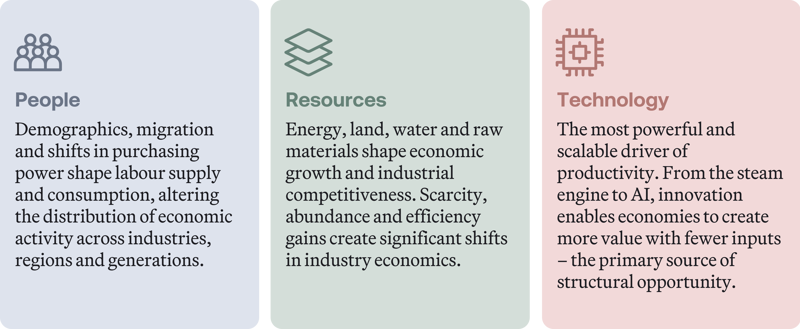
Figure 1: Growth engines
Long-term growth is driven by three engines of economic progress – people, resources and technology – with technology the most powerful driver of productivity and progress.
Source: Sarasin & Partners, 2026
At the heart of Sarasin’s investment philosophy, then, is one question: where is future earnings power going to accrue, and can we invest before the market has fully priced that in? Simply finding a great company exposed to a great theme is not enough. If everybody already knows it and the opportunity is fully priced in, it may not be a good investment. Ultimately, we are looking for a gap between our view of long-term value and the market’s expectations today.
Thematic thinking
Even before I joined the firm, I had always known of Sarasin as a pioneer in thematic investing. From working with the team over recent months, I have become clearer in the conviction that markets systematically underestimate the duration, profitability and value creation associated with the aforementioned structural change that ultimately informs our themes.
So, what is behind our themes? Taking a step back, we start very broadly with the forces driving change – these being the long-term growth engines behind economic progress: people, resources and technology. They help us understand what is changing, whether that is ageing populations, changing patterns of consumption, resource scarcity, electrification, AI or automation.
However, these forces do not operate in isolation. At the same time, we need to understand the market regime in which that change is taking place. You can read more about our post-war regimes here, each built around a set of conventions, behaviours, and institutional arrangements that characterise each period. It is clear that interest rates, fiscal policy, regulation and geopolitics can accelerate a structural change, slow it down, alter its economics or change who ultimately benefits from it.
It is important to note here that we do not think of those growth engines and regimes as two consecutive steps in our process. Rather, the engines help us understand the underlying direction of change. The regime helps us understand how that change is likely to play out economically. We need both to understand where value is likely to accrue.
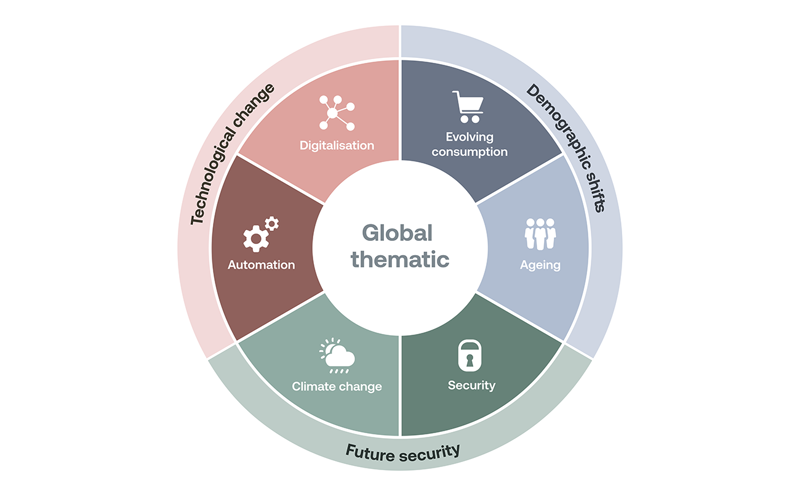
It is through this combined lens that we identify six major thematic areas – Automation, Digitalisation, Evolving consumption, Ageing, Security, and Climate change. We see each as an investment conclusion about a durable change in the world that we believe is sufficiently powerful to reshape industry economics and create sustained opportunities for value creation.
Figure 2: Insight into themes
Themes emerge from the convergence of growth drivers and regimes – they capture shifts that can create sustained value.
Source: Sarasin & Partners, 2026
AI, for example, is a powerful manifestation of our technology growth engine. Our thematic work asks what that technological shift changes economically – whether the falling cost of intelligence reshapes productivity, business models and competitive advantage.
Importantly, a theme tells us where to look for stocks to express it in our portfolios. It does not tell us what to buy. That is where the next part of the process comes in.
Narrowing the universe
Our universe of global equities starts with the MSCI All Country World Index (ACWI), which covers approximately 85% of the global investable equity market. It includes more than 2,400 stocks across 23 developed and 24 emerging market countries.
We must ensure a disciplined way of focusing our research effort on the areas where structural change is most likely to matter. This is where we use quantitative evidence, alongside our thematic judgement, to identify the industries where we see attractive economics and credible structural tailwinds. That gives us our thematic universe: our hunting ground for fundamental research.
Our first task is to narrow that wider universe to a thematic basket of around 1,000 companies for fundamental research, across numerous industries, from automobiles to financials, healthcare, utilities and many others. Our analysis spans evidence around factors such as historical growth, margins, returns and reinvestment. This sits alongside our thematic work to identify the parts of the market where we think structural change is creating the most interesting opportunities. While part of this is quantitative, the aim is to use our systems to test, inform, and challenge our judgement, rather than replace it.
When it comes to selecting individual stocks for our funds and portfolios, judgement and fundamental investing really take over. The kinds of questions we ask when assessing stocks include: which companies are actually going to capture the value? What could their earnings power look like in five or 10 years? How durable is that opportunity? Can they reinvest and compound? What are the risks?
Critically, we ask: what is already in the share price? Our aim, in short, is to find where our view of long-term value differs from what the market expects today.
Our commitment to stewardship
Alongside Sarasin’s thematic approach to investing, I have also long been aware of its heritage as a steward of clients’ capital, something embedded in the investment approach. Indeed, stewardship runs through the whole of the investment process. Before we invest, it gives us additional insight into the environmental, social, governance and regulatory forces affecting industries and companies – it helps us to identify structural change and judge who it favours.
As active, long-term owners, we engage with the companies we hold. Our stewardship approach helps us to understand the risks they face and we are upfront in using our influence to encourage behaviours that support enduring value. We are committed to driving positive change on our clients’ behalf, and we see stewardship as a long-term responsibility to grow and protect their assets.
Clarity and discipline
Since joining Sarasin, I have focused on understanding what is distinctive about our investment approach, where it works well, and where greater clarity and discipline could make it stronger. Our distinct thematic heritage and deep fundamental research capability have truly impressed me, while the team and I are also seeing ways we can evolve our thematic thinking further in the months and years ahead. My objective has not been to reinvent our approach, but to make what is distinctive about it clearer for our clients. I hope this article has helped in that regard, and I will make sure I keep you up to date as we continue on this journey.
Important information
This document is intended for retail investors and/or private clients. You should not act or rely on any information contained in this document without seeking advice from a professional adviser.
This is a marketing communication. Issued by Sarasin & Partners LLP, 50 George Street, London, W1U 7DY. Registered in England and Wales, No. OC329859. Authorised and regulated by the Financial Conduct Authority (FRN: 475111). Website: www.sarasinandpartners.com. Tel: +44 (0)207038 7000. Telephone calls may be recorded or monitored in accordance with applicable laws.
This document has been produced for marketing and informational purposes only. It is not a solicitation or an offer to buy or sell any security. The information on which the material is based has been obtained in good faith, from sources that we believe to be reliable, but we have not independently verified such information and we make no representation or warranty, express or implied, as to its accuracy. All expressions of opinion are subject to change without notice. This document should not be relied on for accounting, legal or tax advice, or investment recommendations. Reliance should not be placed on the views and information in this material when taking individual investment and/or strategic decisions.
Capital at risk. The value of investments and any income derived from them can fall as well as rise and investors may not get back the amount originally invested. If investing in foreign currencies, the return in the investor’s reference currency may increase or decrease as a result of currency fluctuations. Past performance is not a reliable indicator of future results and may not be repeated. Forecasts are not a reliable indicator of future performance.
Neither Sarasin & Partners LLP nor any other member of the J. Safra Sarasin Holding Ltd group accepts any liability or responsibility whatsoever for any consequential loss of any kind arising out of the use of this document or any part of its contents. The use of this document should not be regarded as a substitute for the exercise by the recipient of their own judgement. Sarasin & Partners LLP and/or any person connected with it may act upon or make use of the material referred to herein and/or any of the information upon which it is based, prior to publication of this document.
Where the data in this document comes partially from third-party sources the accuracy, completeness or correctness of the information contained in this publication is not guaranteed, and third-party data is provided without any warranties of any kind. Sarasin & Partners LLP shall have no liability in connection with third-party data.
© 2026 Sarasin & Partners LLP. All rights reserved. This document is subject to copyright and can only be reproduced or distributed with permission from Sarasin & Partners LLP. Any unauthorised use is strictly prohibited.