
Higher and more volatile inflation is changing the investment landscape. We explain why we’re broadening our alternatives allocation beyond gold.
Key points
Commodities offer diversification, particularly when unexpected inflation challenges traditional portfolios.
Global fragmentation provides a more supportive environment for commodities than the previous decade.
We are expanding beyond gold into broad commodities and industrial metals, where demand could outpace supply.
Commodities have long been an established and broad asset class within alternatives, providing potentially valuable diversification from equities and bonds. The nature of different commodities, and how we access them as investments in our portfolios, can vary across different market regimes and economic conditions. Here we describe the opportunities and explain the rationale behind our recent decision to expand our alternatives allocation beyond gold to include a broader basket of commodities and industrial metals in client portfolios.
Our starting point is the Bloomberg Commodity Index (BCOM), a widely used benchmark that splits the universe roughly into a third in energy (36.1%), a third in agriculture and livestock (34.9%), and a third between industrial metals (mainly copper, aluminium, zinc, and nickel, totalling 14%) and precious metals (mainly gold and silver, 15%). Unlike some other alternatives – such as absolute return funds – commodities are not generally suited to downside protection when markets are volatile, although gold does have qualities that make it different. Its historically low correlation to stocks and bonds means it is often preferred as a safe haven during times of geopolitical or economic uncertainty.
Broadly, commodities are not a low-returning asset class and, historically, looking at data back to 1960, they have delivered total returns in excess of cash, bonds, and the industry-standard 60/40 investment strategy (60% in equities, 40% in bonds). However, the flip side is higher volatility, and the long-term volatility-adjusted ratio (the return earned for each unit of risk taken) for commodities significantly lags both equities and bonds over most periods, while drawdowns for the asset class are extremely high. Still, recognising the risk and return characteristics of the wider asset class gives us a good understanding of the role commodities can play in portfolios today.
Why commodities, and why now?
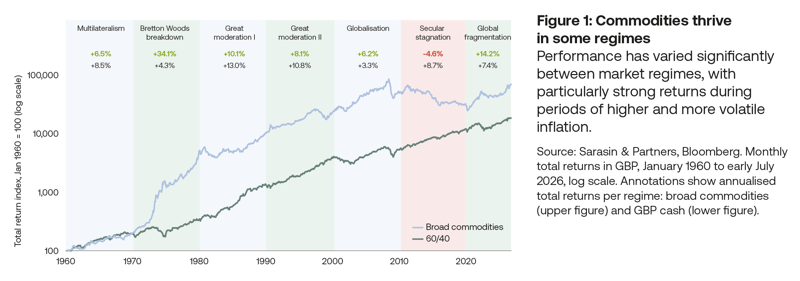
Commodities tend to perform well in exactly the conditions where traditional 60/40 portfolios struggle: periods of unexpected inflation. Returns have clearly varied hugely by economic era – very strong in the 1970s and since 2020, and notably weak during the low-inflation Secular stagnation regime of 2009–2020. That variability matters because it shapes how we think about the asset class today. Commodities are not consistently ‘good’ or ‘bad’ across the board – they are highly sensitive to the market regime.
With our post-war market regimes framework as the basis for our analysis, we can see (figure 1) that there have really only been two periods where performance was extreme in either direction: the Bretton Woods breakdown regime (1968–79), when commodities dramatically outperformed everything else, and the Secular stagnation period (2009–20), when they underperformed cash, bonds, and equities alike. In every other regime, performance has tended to sit close to a 60/40 portfolio – neither a standout nor a drag.
Since 2020, we have been in a regime of Global fragmentation characterised by higher and more volatile inflation, supply chains being restructured, strong government and corporate investment, and less spare capacity in the system to absorb shocks. We see this environment as more like the supportive regimes of the past than the weak one of the last decade – part of why we are broadening beyond gold to improve the overall risk and return profile of client portfolios.
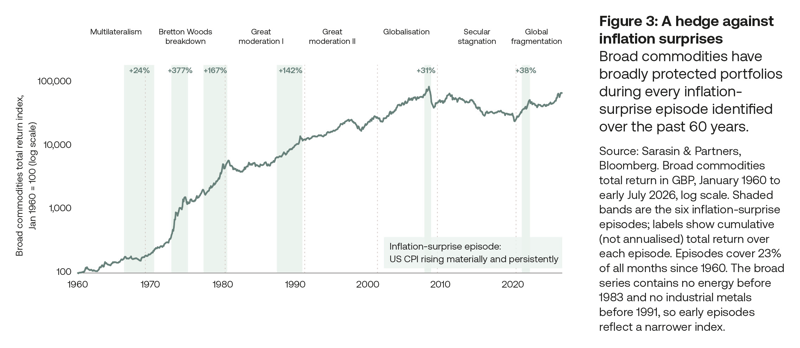
Another supporting factor behind adding commodities is their inherent historical diversification benefit. While we do need to take into account the aforementioned volatile nature of the asset class, backward-looking data (figure 3) suggests that commodities broadly protected portfolios in every inflation shock of the past 60 years, offering a hedge that traditional bonds and equities cannot.
This is no guarantee of future performance, and these inflation-surprise episodes are relatively rare – making up under a quarter of the period we studied – but commodities outperformed a 60/40 portfolio in every single one. That consistency is one of the strongest arguments for holding the asset class as insurance against a stagflationary scenario (high inflation, slow or stagnant economic growth, and elevated unemployment at the same time), even for clients who are not taking a strong directional view on prices.
Building blocks
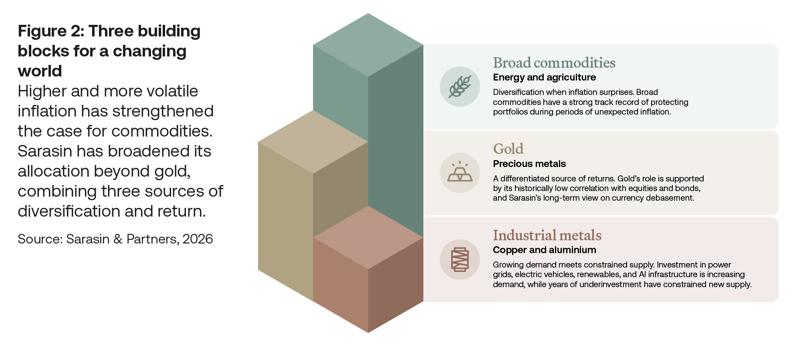
Let’s look in more detail at the sectors that form our commodities allocation, each with a different driver of returns behind it.
The first part of the basket – the broad diversified mix of energy, agriculture, and metals – has perhaps the strongest historical case, as well as the most consistent diversification benefit, particularly during inflation surprises. These sectors have also proven less regime-dependent than commodities’ reputation for volatility might suggest: outside the two extreme episodes we mentioned earlier (during the Bretton Woods breakdown and Secular stagnation regimes), returns have generally tracked broader markets reasonably closely.
Precious metals include silver, platinum, palladium, and a host of others, although the main component of this allocation is gold – which we have held in portfolios for some time now. Our conviction in gold remains, based in part on our long-standing view on currency debasement. Gold has delivered strong, differentiated returns historically, and the case for holding it does not depend on the same industrial supply-and-demand dynamics as other commodities.
Industrial metals (mainly copper and aluminium) are the new addition to the allocation. Unlike the broader basket of commodities and gold, the historical return case alone is not compelling – on the numbers, industrial metals have not historically protected a 60/40 portfolio as reliably as broad commodities have. So this recommendation relies more heavily on our specific forward-looking view: that demand will outpace supply over the next decade, tightening the physical market and supporting prices.
Copper supply is constrained by years of underinvestment in new mining projects, while demand from power grids, electric vehicles, renewables, and AI infrastructure is growing faster than demand from the rest of the market is shrinking. We expect demand to modestly outstrip supply over the next 10 years, supporting prices – although this is a moderate- rather than high-conviction view, given that a large share of demand still comes from slower-growing areas such as construction that could disappoint.
What could go wrong?
No asset class comes without its risks, and commodities are no exception. The main risk we see that could derail the story is a potential return to Secular-stagnation-style conditions – low growth, weak inflation, and ample supply – which is the one environment where commodities have historically disappointed across the board. However, we see this as less likely than average right now, particularly given the structural forces pushing towards higher and more persistent inflation, but it remains the key risk we will be monitoring.
Alongside this macro risk, we will also be watching the physical copper market directly to assess whether the market is behaving in the way our thesis expects, or whether additional supply and demand substitution are keeping the market better balanced than we anticipate.
What this means for portfolios
Sarasin clients will see that their portfolios now have a wider commodities allocation, moving from gold only to include broad commodities and industrial metals. In typical portfolios, the commodities allocation within alternatives has risen from 20% to 25%, funded from alternative equity, such as listed private equity and infrastructure investment companies. This is sized to reflect moderate – rather than high – conviction on the industrial metals component specifically, while our conviction in broad commodities and gold remains higher.
In choosing the right vehicles for the portfolios, we began with a universe of over 350 broad-commodity funds and applied specific hard gates – including track record length, investment structure, and daily dealing – before narrowing further on quantitative measures including drawdown behaviour, consistency of returns, and scale. A small shortlist went through manager meetings and full due-diligence questionnaires, from which two funds emerged as our highest-conviction recommendations.
JSS Commodity – Transition Enhanced implements broad commodities exposure through a constant-mix, direction-agnostic strategy. In short, this means monthly rebalancing back to equal weights within each sector, which systematically sells recent outperformers and buys underperformers.
Secondly, as a complementary addition, we also selected Neuberger Berman Commodities. Its process is built on the idea that in commodities, unlike equities, sustained high volatility is usually a sign of acute physical supply stress rather than a risk investors should be paid to hold. The fund systematically reduces exposure to commodities showing that kind of stress-driven volatility, while allowing structural overweight positions in commodities with calmer, more persistent scarcity dynamics.
We have deliberately chosen two managers with genuinely different processes, rather than one. Beyond the diversification of investment approach this brings, using two funds also lets us build a meaningful commodities position without concentrating the allocation too heavily in a single vehicle.
Important information
This document is intended for retail investors and/or private clients. You should not act or rely on any information contained in this document without seeking advice from a professional adviser.
This is a marketing communication. Issued by Sarasin & Partners LLP, 50 George Street, London, W1U 7DY. Registered in England and Wales, No. OC329859. Authorised and regulated by the Financial Conduct Authority (FRN: 475111). Website: www.sarasinandpartners.com. Tel: +44 (0)207038 7000. Telephone calls may be recorded or monitored in accordance with applicable laws.
This document has been produced for marketing and informational purposes only. It is not a solicitation or an offer to buy or sell any security. The information on which the material is based has been obtained in good faith, from sources that we believe to be reliable, but we have not independently verified such information and we make no representation or warranty, express or implied, as to its accuracy. All expressions of opinion are subject to change without notice. This document should not be relied on for accounting, legal or tax advice, or investment recommendations. Reliance should not be placed on the views and information in this material when taking individual investment and/or strategic decisions.
Capital at risk. The value of investments and any income derived from them can fall as well as rise and investors may not get back the amount originally invested. If investing in foreign currencies, the return in the investor’s reference currency may increase or decrease as a result of currency fluctuations. Past performance is not a reliable indicator of future results and may not be repeated. Forecasts are not a reliable indicator of future performance.
Neither Sarasin & Partners LLP nor any other member of the J. Safra Sarasin Holding Ltd group accepts any liability or responsibility whatsoever for any consequential loss of any kind arising out of the use of this document or any part of its contents. The use of this document should not be regarded as a substitute for the exercise by the recipient of their own judgement. Sarasin & Partners LLP and/or any person connected with it may act upon or make use of the material referred to herein and/or any of the information upon which it is based, prior to publication of this document.
Where the data in this document comes partially from third-party sources the accuracy, completeness or correctness of the information contained in this publication is not guaranteed, and third-party data is provided without any warranties of any kind. Sarasin & Partners LLP shall have no liability in connection with third-party data.
© 2026 Sarasin & Partners LLP. All rights reserved. This document is subject to copyright and can only be reproduced or distributed with permission from Sarasin & Partners LLP. Any unauthorised use is strictly prohibited.